One Brief, Every Format: Turn a Cultural Moment Into a Poster, a Video, and a Landing Page
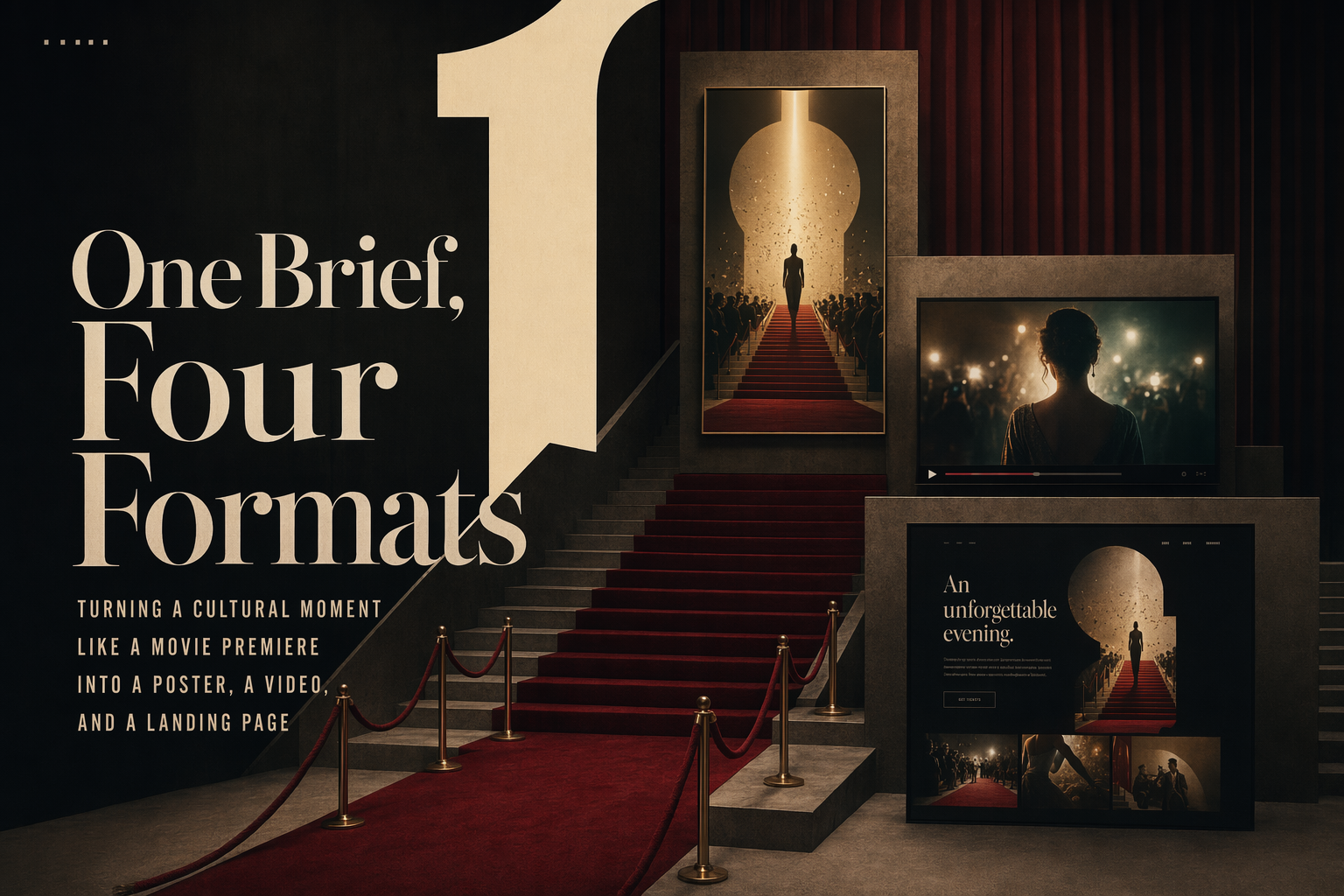
A blockbuster premiere weekend is not just a marketing opportunity. It's a design opportunity — a short window where a poster, a video, and a landing page all need to exist at once, and none of them can wait for a designer's calendar to open up.
This week, a generation-defining ensemble cast and a director whose openings are already cultural events are driving a four-day countdown across TikTok and entertainment press. When a film like that opens, it creates a short, sharp spike of shared attention. Big studios and their official partners will own the direct conversation. But the visual and creative language around that moment — countdown graphics, watch-party promos, "the wait is over" campaigns — is wide open for any brand that can move fast, without pretending to be the studio.
This is not a review, and it is not a case study built around one movie. It is a playbook for a pattern that repeats every time a cultural moment creates a short creative window: a product launch, an awards show, a season premiere, a sports final. The common problem is always the same — you need a poster, a short video, and a landing page, at the same time, on a deadline measured in days, and you probably do not have a designer, a video editor, and a developer all free this week.
Why This Is a Design Problem, Not Just a Copywriting One
Most "real-time marketing" advice focuses on captions and post timing. That undersells what a moment like a premiere weekend actually demands. A countdown post needs a poster-quality visual, not a stock photo with text over it. A "the wait is over" campaign needs a short video that feels intentional, not a slideshow. And any of it that drives traffic needs a landing page that matches the visual language of the poster and video — not a generic template with the campaign copy pasted in.
Three formats, one moment, one deadline. Historically, that meant three different tools, three different skill sets, and three different people to coordinate. That is exactly the bottleneck that determines who gets to participate in a fast-moving cultural moment and who watches it pass by.
The Rule That Matters Most: Reference the Moment, Not the IP
Before anything else: when the cultural moment is someone else's copyrighted release — a film, a show, an album — the safe posture is to reference the moment, not the intellectual property. That means:
- No stills, poster art, or cast likeness from the film itself.
- No wording that implies an official partnership, sponsorship, or endorsement.
- Build your own poster, your own visual identity, around the shared feeling — anticipation, ensemble energy, "the wait is over" — not the studio's actual assets.
This is the same boundary a coffee shop respects when it posts about "exam season" without licensing anything. The cultural moment is public. The IP is not.
Start With One Brief, Not Three Separate Projects
The instinct is to open a design tool for the poster, a video tool for the clip, and a website builder for the landing page — three blank canvases, three separate creative decisions, three chances for the visual language to drift apart by the time all three are done.
A better starting point is one brief that defines the angle, audience, brand voice, visual tone, color and typography direction, the formats needed, and the explicit boundary (no likeness, no logos, no implied endorsement). That brief becomes the shared source for the poster, the video script and shot direction, and the landing page copy and layout — so all three come out looking and reading like they belong to the same campaign, because they were generated from the same starting point instead of three independent guesses.
Example brief: "We are an independent bookstore. We want to build a small in-store and online campaign around this weekend's big ensemble-cast movie release, using an 'epic stories worth the wait' angle — no references to the film's plot, title, or cast beyond the general theme. We need one event poster in a warm, cinematic palette, one 15-second countdown video for Instagram and TikTok, and one landing page for our 'epic reads' in-store display, in English and Spanish."
What "One Brief, Every Format" Actually Produces
The poster. A poster-quality visual isn't a caption with a background — it has hierarchy, a focal point, and a color story that reads at a glance, sized for both a printed in-store display and a square social crop. Generated from the brief, it should already match the campaign's tone before a human touches it.
The video. A short countdown or teaser clip, built from the same visual language as the poster — same palette, same typography, same emotional register — not a separate creative decision made from scratch in a different tool.
The landing page. Wherever the poster and video drive traffic, the landing page needs to look like it belongs to the same campaign: same hero treatment, same copy voice, same call to action — built and editable without a developer, so a same-day copy tweak doesn't need a ticket.
The point isn't that AI replaces creative judgment. It's that starting from one brief instead of three blank canvases means the poster, video, and landing page start in agreement with each other, and a human only has to edit toward "right," not build from zero three separate times.
The 96-Hour Window, Broken Down
Now through release day (countdown phase): the poster and landing page go live first. Countdown-style visuals and "the wait is almost over" framing work for retail promos, restaurant specials, or event RSVPs, without touching plot or cast.
Release day: the video does the work. A short clip built for opening-day energy — tied to your own storefront or event, not the film's marketing — outperforms a recap or review post, which risks sounding like unofficial commentary on someone else's IP.
Opening weekend: the landing page becomes the hub. Observation-style social posts point back to it; this is where the campaign's actual conversion happens.
The week after: fold the assets into evergreen content. A poster template built for "anticipation marketing" and a landing page pattern for "countdown campaigns" can both be reused for the next launch, product drop, or seasonal moment — long after this particular premiere is old news.
Angles That Transfer Beyond This Weekend
The anticipation angle. Countdown visuals and "worth the wait" framing apply to any product launch, waitlist, or seasonal drop — the poster template outlives the movie news cycle.
The ensemble angle. "Bring your whole crew" promotions borrow the multi-star energy of the moment without naming anyone in it.
The epic-scale angle. Positioning a small offer as "your own odyssey" — a journey, a quest, a long-awaited payoff — is a durable visual and copy metaphor that doesn't expire when the box office numbers do.
The localization angle. Publish the poster and landing page in two or three languages and let the visual campaign, not just the caption, feel native to each market.
Frequently Asked Questions
Can AI generate a poster, a video, and a landing page from the same brief?
Yes — a single campaign brief that defines audience, angle, tone, and boundaries can be expanded into a coordinated set of formats: an event poster, a short video, a landing page, and social captions, all sharing the same visual language and message instead of being rebuilt separately in different tools.
What's a safe way to reference a blockbuster movie release in brand marketing without implying a partnership?
Reference the cultural moment — anticipation, premiere-night energy, ensemble-cast excitement — rather than the film's plot, title art, or cast likeness, and avoid any wording or imagery that suggests official association or sponsorship.
How do small brands create event marketing visuals without a designer or video editor?
An AI workspace that generates poster, video, and landing page assets from one brief removes the need for a dedicated designer or editor on standby. The brief carries the creative direction; the workspace produces platform-ready outputs a non-technical person can still edit afterward.
How is generating a poster, video, and landing page from one brief different from using separate AI tools for each?
Separate tools for image, video, and web design each need their own prompt, and small wording or brand changes have to be repeated in every tool by hand. A single brief shared across formats keeps the poster, video, and landing page visually and message-consistent, and a change to the brief propagates to all three instead of only one.
The Real Advantage Is Starting From One Place
Small brands do not win a cultural moment by out-producing bigger competitors. They win by looking coherent — one visual language across a poster, a video, and a landing page — in the exact window their audience is already paying attention. That coherence is hard to fake when it's built from three separate starting points on a three-day deadline. It's the default outcome when it's built from one.
In folkos.ai, that's the underlying idea: one brief becomes the poster, the video, and the landing page, without losing the thread between them. That matters most exactly when the window is measured in hours, not weeks.
Folkos: The agent workspace, reimagined.
Build once, remix everywhere.
Get started free →