Web Design Is Becoming a Multi-Format Workflow, Not a Single Page
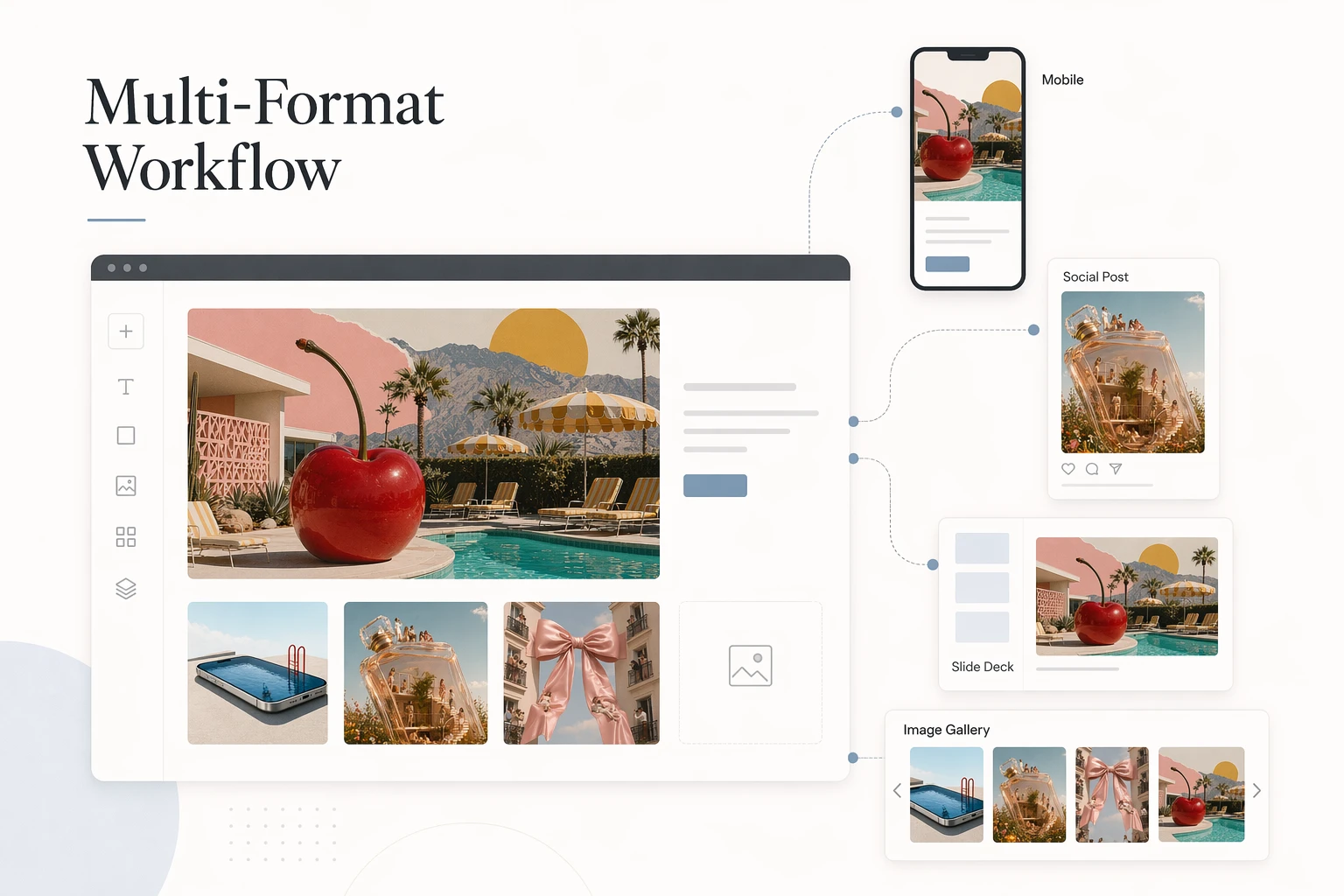
The most important question in web design is no longer “can we build the page?” It is “can the page become the rest of the work?”
For years, web design was treated as a destination. A team wrote a brief, designed a landing page, revised the copy, handed the work to development, and eventually published something that lived at a URL. The website was the finish line.
That model is starting to feel too small for how modern teams actually launch products, campaigns, and companies. A website is still important, but it is rarely the only output a team needs. The same idea also has to become product positioning, hero copy, onboarding screens, launch graphics, short-form video scripts, investor slides, sales collateral, and social content. The page is not the destination anymore. It is one format inside a larger production system.
This is why the next era of web design will look less like a page builder and more like a multi-format AI workspace. Tools like Framer and Webflow have made site creation faster and more visual. Canva has trained teams to expect brand-consistent design across formats. But the deeper workflow challenge is not simply generating a beautiful web page. It is keeping the strategy, copy, visuals, and derivative assets connected after the first page exists.
The Web Page Is Becoming a Source File
A landing page used to be an output: the thing a team published after strategy and design were already done. Increasingly, it is becoming a source file. It contains the clearest expression of the product’s promise, audience, offer, proof, and visual direction. Once that structure exists, the obvious question is: why should every other format start from scratch?
If the hero section defines the product promise, that same promise should inform the ad headline. If the feature blocks explain the product’s value, they should become the skeleton of a launch thread, a sales one-pager, or a short explainer video. If the visual system works on the page, it should carry into thumbnails, deck slides, product cards, and email banners.
In a disconnected tool stack, this inheritance does not happen naturally. The web page lives in one tool, the launch deck in another, the graphics somewhere else, and the video brief in a document. Every handoff introduces interpretation loss. Every new format becomes a partial rewrite of something the team already solved.
An agent workspace changes the center of gravity. The page is no longer an isolated deliverable. It becomes part of a living workspace where the underlying idea can be reused, remixed, and adapted into every adjacent format.
What Web Design Teams Actually Need Now
The fastest teams are not necessarily the ones with the most designers or the biggest tool budget. They are the teams that reduce translation cost. They can move from positioning to page, from page to assets, from assets to campaign, and from campaign to iteration without constantly re-explaining the same context.
That changes the requirements for a modern web design workflow. The workspace needs to understand copy and layout, but also the work around the page: brand systems, product screenshots, customer language, campaign variants, reusable sections, and post-launch iteration. A web page that cannot feed anything else is increasingly expensive, even if it is beautiful.
This is where Folkos fits a different category than a simple AI website generator. The value is not only that an agent can help create a page. The value is that the page can sit inside a broader workspace where other agents can build from it: a presentation agent can turn the narrative into a pitch deck, an image agent can produce launch visuals, a video agent can draft a product explainer, and a document agent can turn the same structure into a launch brief.
Why “Generate a Website” Is Too Narrow
Prompt-to-site tools are useful because they collapse the blank-canvas problem. They give teams a first version faster. But first versions are not where most real work ends. Real work involves revision, reuse, alignment, and adaptation across formats.
A founder does not only need a landing page. They need the page, the deck, the product demo script, the investor update, and the launch post to say the same thing. A marketing team does not only need a campaign microsite. They need every asset around the campaign to inherit the same message and visual system. A creator does not only need a portfolio page. They need the portfolio to become a media kit, a newsletter introduction, and a set of social proof assets.
That is the difference between generation and workflow. Generation makes an artifact. Workflow makes the artifact useful in the context of everything else the team has to produce.
The New Standard for AI Web Design
The next standard will not be “AI can build a website.” That is already becoming table stakes. The more useful standard is whether the work remains editable, reusable, and connected after the page appears.
Can the positioning be reused in a pitch deck? Can the feature sections become an email sequence? Can the product visuals be reworked into social assets without rebuilding the brief? Can the team keep the page, the campaign, and the internal documents aligned as the product changes?
For small teams, this matters because resources are limited. For larger teams, it matters because coordination is expensive. In both cases, the advantage comes from making the first piece of work compound into the next one.
Web design is not disappearing into automation. It is expanding into a more strategic role. The best page is no longer just the one that looks good and converts. It is the one that becomes a reusable foundation for the entire go-to-market system.
Folkos: The agent workspace, reimagined.
Build once, remix everywhere.
Get started free →