The World Cup Quarterfinals Are a 72-Hour Marketing Gold Rush. Small Brands Can Still Win
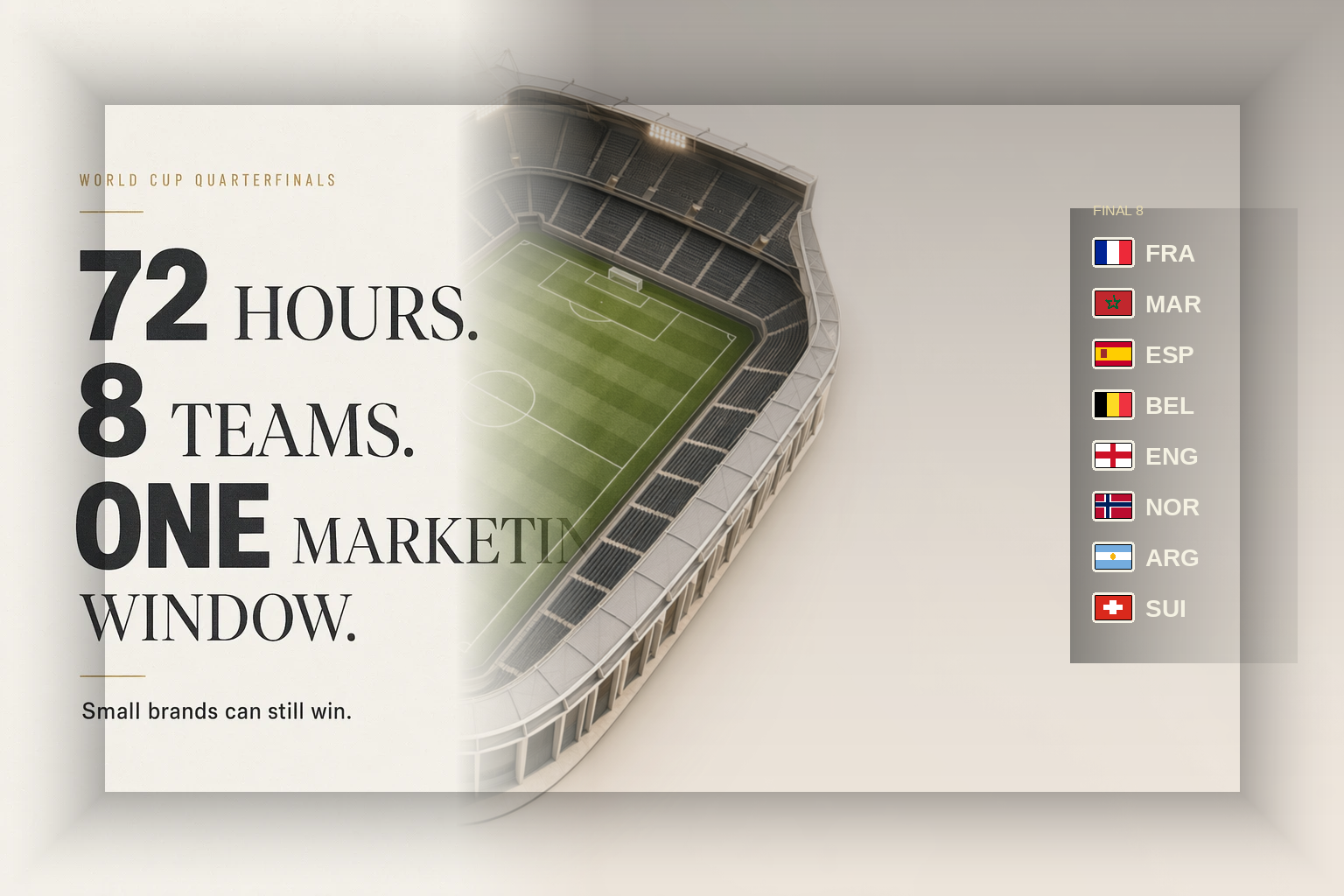
The quarterfinals are not just football. They are a 72-hour attention market where small brands can look faster, smarter, and more local than teams ten times their size.
The World Cup quarterfinals have a special kind of electricity. The casual viewers are awake now. The national storylines are sharper. Every match feels like a referendum on pride, history, pressure, and heartbreak. In 2026, the quarterfinal window is especially rich: France vs Morocco, Spain vs Belgium, England vs Norway, and Argentina vs Switzerland give marketers four completely different emotional territories to work with.
For large brands, this is the moment when global agencies start moving their war rooms. For small brands, it can feel impossible. You do not have a sports desk. You do not have a designer on standby. You do not have a localization team for French, Spanish, Arabic, Dutch, German, English, or Norwegian. You probably do not have time to turn every match into five formats before the conversation moves on.
But that is exactly why this moment is interesting. Real-time sports marketing used to reward headcount. Now it rewards workflow. If you can turn one good brief into multiple languages, multiple formats, and multiple platform-native assets quickly, you can participate without pretending to be Coca-Cola.
The Quarterfinals Are Different From the Group Stage
Group stage content can be broad: predictions, memes, national pride, “who are you supporting?” posts. Quarterfinal content has to be sharper. There are fewer teams, stronger emotions, and a much shorter window. Every match has a distinct narrative.
France vs Morocco is about power, history, pride, and underdog energy. Spain vs Belgium gives you style, possession, discipline, golden generations, and tactical contrast. England vs Norway brings pressure, expectation, and northern European confidence. Argentina vs Switzerland creates a clean contrast between chaos, magic, precision, and structure.
You do not need to use every match. In fact, you probably should not. The best small-brand sports marketing starts by asking: where does our audience already care, and which match gives us a natural angle?
Start With One Brief, Not Twenty Posts
The temptation is to open a blank document and start writing posts one by one. That is how small teams lose the moment. By the time the fifth caption is done, the first one is already stale.
A better workflow starts with one brief. The brief should include the match, audience, brand voice, languages, platforms, visual tone, safe boundaries, and the action you want people to take. That single brief becomes the source for every asset.
For example: “We are a small productivity app targeting freelance creators in Europe. We want to react to France vs Morocco with a respectful, energetic angle about pressure, focus, and showing up when the stakes are high. We need English, French, and Arabic captions; one LinkedIn post; three X posts; two Instagram story frames; one short email opener; and one landing page hero variant.”
That is the difference between prompting and campaigning. A prompt asks for one output. A campaign brief gives an AI workspace enough context to produce a connected set of assets.
The Multilingual Advantage
World Cup marketing is global by default. That does not mean every small brand needs to become a global brand overnight. It means language is one of the easiest ways to make a campaign feel less generic.
A multilingual marketing content generator is useful only if it does more than translate words. A good localized post changes rhythm, references, tone, and emotional emphasis. French football content does not feel the same as English football content. Arabic fan culture has its own emotional range. Spanish and Dutch sports conversations move differently. German and Swiss audiences often respond better to precision than hype.
This is where “AI brief to multiple languages” becomes more powerful than copy-paste translation. The source brief stays consistent, but each market gets a version that feels written for people there, not translated at them.
In folkos.ai, the useful idea is simple: one brief can become multiple languages, multiple formats, and multiple assets without losing the original strategy. That matters when the trend window is measured in hours.
Real-Time Sports Marketing Without a Team
If you do not have a team, your workflow has to be brutally simple. Do not try to cover every minute of every match. Pick the moments that match your brand.
Before the match: publish prediction-style or tension-building content. Make it about the emotional setup, not the score. “Pressure reveals systems” works better for a productivity brand than “France will win 2–1.”
At halftime: use observation posts. What is happening? What surprised people? What is the mood? Halftime is perfect for quick X posts, Instagram stories, and short LinkedIn reflections.
After the final whistle: move fast but stay thoughtful. The winner gets celebration content. The loser gets empathy content. The real viral opportunity is often not the result but the emotional truth people are already feeling.
The morning after: turn the moment into evergreen content. A post-match lesson can become a newsletter intro, a blog hook, or a campaign landing page angle.
Viral Angles Small Brands Can Actually Use
The pressure angle. Use quarterfinal pressure as a metaphor for launches, deadlines, founder life, creative work, or high-stakes decision-making.
The localization angle. Publish the same campaign idea in three languages and invite audiences to compare which one feels most natural.
The underdog angle. Do not force it. But when a match carries underdog energy, small brands can honestly connect with that feeling: doing more with less, staying calm, earning attention.
The “one brief, every asset” angle. Show the behind-the-scenes workflow: one match brief becoming captions, story frames, email copy, and a landing page. This is meta-content, and audiences love seeing how things are made.
The fan-language angle. Ask fans to submit the most untranslatable phrase from the match. Turn those into a carousel or thread. It is playful, multilingual, and native to the World Cup.
A 30-Minute Workflow for the Quarterfinals
Minute 0–5: Choose the match and audience. Do not start with content. Start with fit. Which match does your audience care about?
Minute 5–10: Write the brief. Match, emotion, brand angle, languages, formats, boundaries, CTA.
Minute 10–20: Generate the asset set. Ask for platform-native outputs: X posts, LinkedIn post, Instagram story copy, email opener, image prompt, landing page hero, short video script.
Minute 20–25: Localize. Create language variants from the same brief. Do not only translate. Ask for cultural adaptation.
Minute 25–30: Edit like a human. Remove anything too generic, too forced, too nationalistic, or too promotional. Real-time sports marketing should feel fast, not careless.
What Not to Do
Do not hijack grief. Do not use national identity as a gimmick. Do not pretend your brand is part of the match if it is not. Do not publish the same caption in six languages and call that localization. Do not make jokes you cannot explain to someone from the country you are referencing.
The safest content is usually not the blandest content. It is the content that understands the emotional line. You can be funny, sharp, useful, and fast without being opportunistic.
The SEO Layer: Capture the Search Before and After the Match
World Cup search behavior has two peaks: before the match and after the match. Before the match, people search for predictions, fixtures, lineups, memes, social media ideas, and campaign examples. After the match, they search for reactions, highlights, quotes, lessons, and what the result means.
This is where SEO and real-time content can work together. A small brand can publish a timely blog post or landing page around phrases like “World Cup marketing content AI,” “world cup social media content tool,” “real-time sports marketing generator,” “world cup marketing without a team,” and “sports marketing for small brands.” The trick is to make the page genuinely useful, not just keyword-shaped.
A strong page might include match-specific hooks, multilingual caption examples, a 30-minute workflow, and a downloadable brief template. That gives search engines something useful to index and gives readers a reason to stay.
The Real Advantage Is Not Being Everywhere
Small brands do not win the World Cup conversation by posting more than everyone else. They win by being fast, specific, and culturally aware in the exact places their audience already pays attention.
The quarterfinals are a perfect test because the window is short. You cannot build a giant campaign from scratch. You need a system that turns one idea into many usable outputs quickly.
That is the real promise of an AI workflow in sports marketing: not replacing the creative idea, but making the idea travel. One brief. Multiple languages. Every asset you need before the moment disappears.
Folkos: The agent workspace, reimagined.
Build once, remix everywhere.
Get started free →